

Restaurant Equipment Procurement Guide UAE: Avoid Expensive Mistakes
8 September 2026
Restaurant equipment procurement in the UAE is much more than requesting quotations and selecting the lowest price.
A commercial kitchen is a complex operational system. Equipment must match the menu, production capacity, available space, workflow, utilities, staff requirements, maintenance strategy, and long-term business objectives.
A procurement decision that looks inexpensive on paper can become costly if the equipment is incorrectly specified, difficult to maintain, incompatible with the kitchen infrastructure, or unsuitable for the restaurant's production volume.
This is why professional restaurant equipment procurement in the UAE should begin before purchasing decisions are made.
Whether you're opening a restaurant in Dubai Marina, Downtown Dubai, Jumeirah, Business Bay, DIFC, Palm Jumeirah, or Dubai Hills, or developing a foodservice project in Abu Dhabi, Sharjah, Ajman, Ras Al Khaimah, Fujairah, Al Ain, or Umm Al Quwain, a structured procurement process can significantly reduce unnecessary risk.
What Is Restaurant Equipment Procurement?
Restaurant equipment procurement is the process of identifying, specifying, comparing, purchasing, delivering, installing, and commissioning the equipment required for a commercial kitchen.
It can involve:
Cooking equipment
Food preparation equipment
Bakery equipment
Beverage equipment
Dishwashing systems
Storage equipment
Ventilation-related equipment
Smallwares and kitchen accessories
A professional procurement process connects these purchases to the actual kitchen design and operational requirements.
Why Restaurant Equipment Procurement Goes Wrong
Many procurement problems begin before the first quotation is received.
Common causes include:
Buying equipment before finalizing the kitchen design
Choosing equipment based only on price
Incomplete equipment specifications
Incorrect capacity calculations
Poor MEP coordination
Ignoring delivery lead times
Choosing unsuitable brands
No clear warranty requirements
Limited spare-parts support
Poor coordination between suppliers
Failing to plan installation
No commissioning or staff training
The solution is not necessarily to spend more.
The solution is to procure more strategically.
Start With the Menu, Not the Equipment Catalog
One of the most important procurement principles is simple:
Your menu should determine your equipment requirements.
A pizza restaurant may require:
Pizza ovens
Dough mixers
Refrigerated preparation counters
Dough preparation equipment
Pizza refrigeration
Holding equipment
A specialty café may require:
Espresso machines
Coffee grinders
Blenders
Ice machines
Refrigeration
Juice equipment
Beverage stations
A hotel kitchen may require completely different equipment for:
Breakfast production
À la carte service
Banquets
Pastry
Staff meals
Room service
Therefore, the procurement process should begin by translating the menu into production requirements and equipment categories.
Build a Commercial Kitchen Equipment Schedule
Before contacting suppliers, prepare an equipment schedule.
A useful schedule can include:
Category | Equipment | Quantity | Capacity | Utilities | Priority |
Cooking | Commercial Oven | 1 | Based on production | Electrical/Gas | High |
Cooking | Fryer | 2 | Based on menu | Gas/Electric | High |
Refrigeration | Upright Refrigerator | 2 | Based on storage | Electrical | High |
Preparation | Work Table | As required | Custom | — | High |
Warewashing | Dishwasher | 1 | Based on covers | Electrical/Water/Drain | High |
Storage | Shelving | As required | Site-specific | — | Medium |
The exact equipment list will vary by project.
The purpose of the schedule is to ensure that every required item is identified before quotations are compared.
Define Equipment Specifications Before Requesting Quotes
A common procurement mistake is asking different suppliers to quote for "a commercial oven" without providing detailed requirements.
That can result in quotations for completely different products.
Instead, specify relevant requirements such as:
Equipment type
Capacity
Dimensions
Output
Temperature range
Electrical requirements
Gas requirements
Material
Controls
Accessories
Installation requirements
Warranty
Service requirements
This creates a much more meaningful comparison between suppliers.
Compare Equipment on a Like-for-Like Basis
A procurement manager should avoid comparing quotations based only on the final total.
For example:
Supplier A: AED X
Supplier B: AED Y
Supplier C: AED Z
This doesn't tell you whether the three proposals offer equivalent equipment.
One quotation may include:
Installation
Accessories
Delivery
Commissioning
Warranty
while another may include equipment supply only.
A proper comparison should therefore evaluate the complete scope of supply.
Create a Restaurant Equipment Procurement Checklist
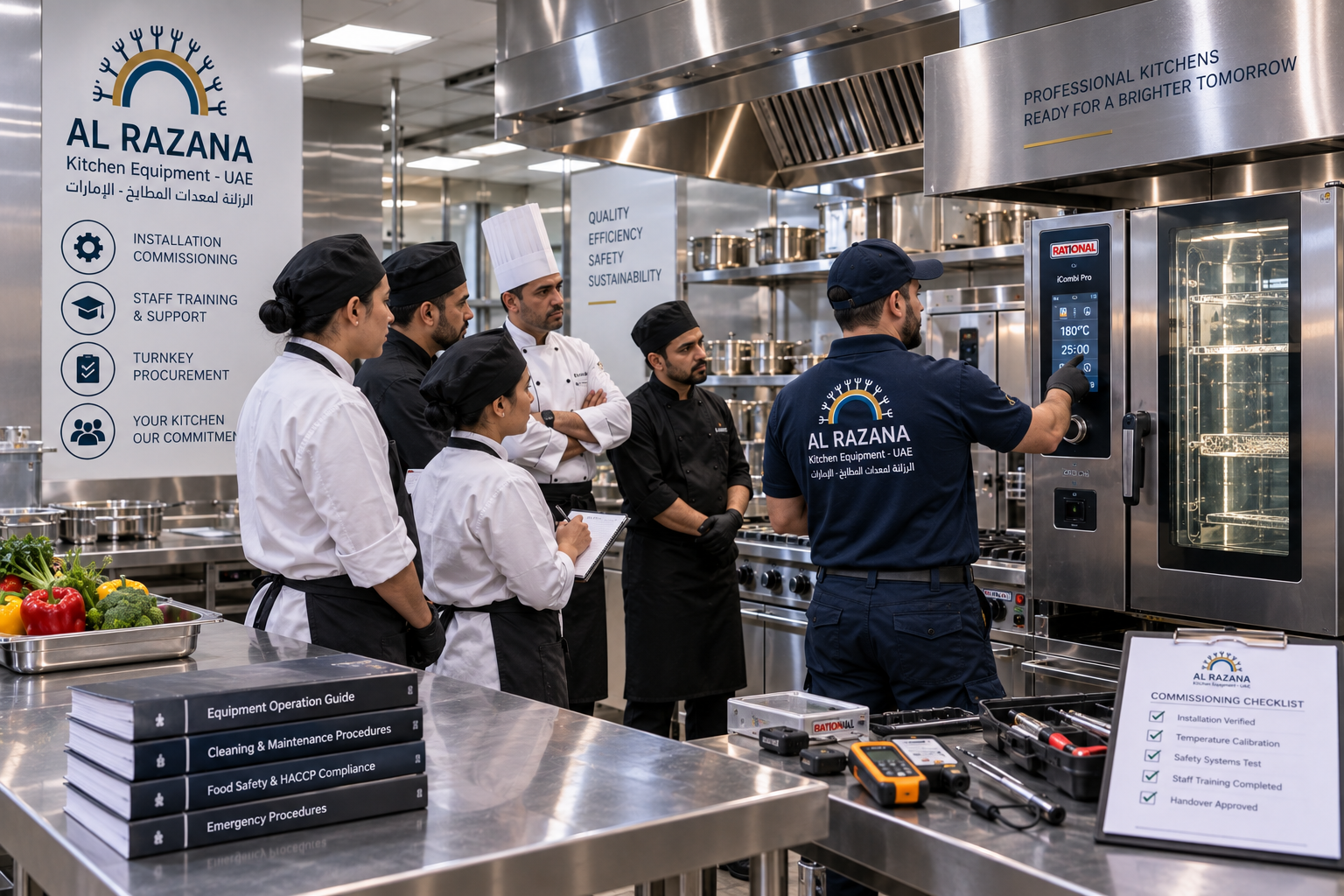
Before approving an equipment quotation, check:
Correct equipment type
Correct quantity
Correct dimensions
Required capacity confirmed
Technical specifications reviewed
Electrical requirements confirmed
Gas requirements confirmed where applicable
Water connection requirements confirmed
Drainage requirements confirmed
Ventilation requirements confirmed
Accessories included
Delivery included
Installation included
Commissioning included
Staff training considered
Warranty terms reviewed
Spare-parts availability checked
Maintenance support confirmed
Delivery timeline confirmed
This simple process can eliminate many procurement surprises.
How to Evaluate Restaurant Equipment Suppliers in the UAE
The supplier should be evaluated alongside the equipment.
Technical Knowledge
Can the supplier explain why a particular model is suitable for your operation?
Product Portfolio
Does the supplier provide the categories required for the project?
Design Capability
Can the supplier coordinate equipment with the kitchen layout?
Installation Capability
Can the supplier install and commission the equipment correctly?
After-Sales Support
Is there a clear process for maintenance and technical support?
Spare Parts
Can critical replacement parts be obtained when needed?
Project Experience
Has the supplier worked with similar restaurants, cafés, hotels, catering kitchens, or foodservice operations?
Turnkey Capability
Can the supplier coordinate multiple project elements rather than supplying isolated products?
A supplier that can support the complete project can simplify procurement considerably.
Brand Selection Is Only Part of Procurement
Selecting professional brands is important, but brand reputation alone should not determine the purchase.
The equipment should be assessed based on:
Application
Capacity
Performance
Reliability
Energy efficiency
Maintenance
Local support
Spare parts
Warranty
Total cost of ownership
For a deeper comparison, see Best Restaurant Equipment Brands UAE: How to Compare Quality & Performance.
Don't Choose Equipment Based Only on Purchase Price
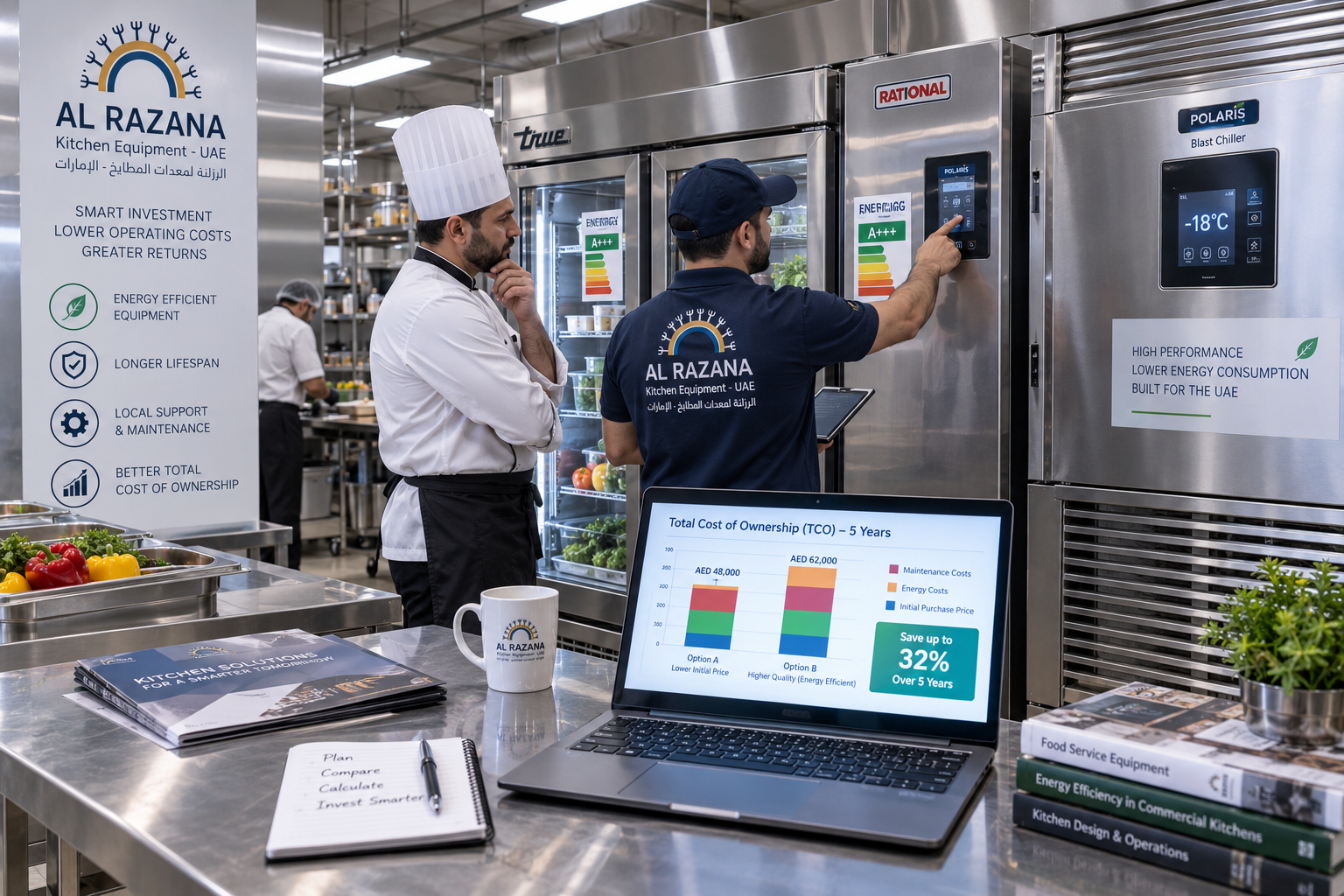
The lowest quotation isn't always the lowest-cost solution.
Consider the full lifecycle:
Purchase → Installation → Energy → Maintenance → Repairs → Downtime → Replacement
A cheaper machine that requires frequent maintenance or cannot handle peak production may create higher operational costs.
Procurement managers should therefore consider total cost of ownership rather than initial purchase price alone.
Consider Energy Consumption
Energy consumption is especially important for equipment that operates for long periods.
Procurement teams should review efficiency when selecting:
Commercial ovens
Fryers
Refrigerators
Freezers
Blast chillers
Dishwashers
Ice machines
Coffee equipment
For Dubai operations, electricity consumption should be considered as part of the restaurant's broader operating-cost model.
See Energy-Efficient Commercial Kitchen Equipment UAE: Lower Operating Costs for a dedicated guide.
Coordinate Procurement With Kitchen Design
Equipment procurement and kitchen design should not operate as separate processes.
Equipment specifications affect:
Kitchen dimensions
Workstation locations
Electrical loads
Gas connections
Water connections
Drainage
Ventilation
Extraction
Staff circulation
Service access
For example, purchasing a large commercial oven without confirming its position, ventilation requirements, electrical load, and service clearance can create expensive modifications later.
For new projects, finalize the kitchen design and equipment specifications before major procurement decisions are approved.
Procurement and Stainless Steel Fabrication
Custom stainless steel fabrication should also be coordinated with equipment procurement.
Fabrication can include:
Work tables
Preparation counters
Sinks
Shelving
Cabinets
Equipment stands
Storage counters
Service counters
Dimensions should be coordinated with the final equipment specifications.
If equipment dimensions change after fabrication has already been completed, modifications may become necessary.
This is why accurate equipment schedules and site measurements are critical.
Manage Equipment Lead Times
Not every piece of commercial kitchen equipment has the same availability.
Some products may be readily available, while specialized equipment may require additional procurement time.
Procurement managers should identify:
Available stock
Manufacturing lead time
Shipping requirements
Expected arrival
Installation date
Commissioning date
This is particularly important when opening dates are fixed.
A delayed oven, refrigeration system, dishwasher, or specialized piece of equipment can affect the entire opening schedule.
Don't Forget Delivery and Site Access
Equipment delivery should be planned before the purchase order is finalized.
Consider:
Building access
Loading areas
Delivery restrictions
Door dimensions
Elevators
Staircases
Equipment dimensions
Installation route
Storage on site
This becomes particularly important for projects inside Dubai malls, hotels, towers, and mixed-use developments, where delivery procedures may be more restrictive than a standalone property.
Factory Acceptance, Inspection and Delivery Checks
Before accepting equipment, procurement teams should verify that the delivered products match the approved specifications.
Check:
Model number
Quantity
Dimensions
Accessories
Visible condition
Documentation
Warranty information
Installation requirements
For major projects, a structured receiving process can help identify discrepancies before installation begins.
Installation Should Be Part of the Procurement Strategy
Equipment procurement shouldn't end when the products arrive.
Commercial equipment often requires professional installation.
Depending on the equipment, installation may involve:
Electrical connections
Gas connections
Plumbing
Drainage
Ventilation
Refrigeration
Positioning
Leveling
Calibration
Installation should therefore be coordinated with the wider kitchen project.
Commissioning Before Opening
Commissioning confirms that the equipment is functioning correctly under operating conditions.
It may involve:
Equipment startup
Temperature checks
Operational testing
Safety checks
Control verification
Calibration
Water and drainage testing
Refrigeration testing
Staff should also understand the correct operating procedures.
This is particularly important for complex equipment such as combi ovens, blast chillers, specialized refrigeration, and automated cooking systems.
Common Restaurant Procurement Mistakes in the UAE
Mistake 1: Buying Before Designing
Equipment is purchased before confirming the final kitchen layout.
Mistake 2: Choosing the Cheapest Quote
Price is treated as the primary selection criterion.
Mistake 3: Ignoring Utilities
Electrical, gas, plumbing, drainage, or ventilation requirements aren't properly checked.
Mistake 4: Buying Oversized Equipment
Large equipment is selected without considering actual production requirements.
Mistake 5: Ignoring Service Access
Equipment is installed without sufficient room for maintenance.
Mistake 6: Mixing Incompatible Equipment
Multiple products are selected without considering utility and operational compatibility.
Mistake 7: No Clear Warranty Scope
The buyer assumes everything is covered without reviewing warranty terms.
Mistake 8: Ignoring Spare Parts
The equipment is purchased without confirming the availability of critical replacement components.
Mistake 9: Forgetting Accessories
Essential accessories are discovered only after the equipment arrives.
Mistake 10: No Commissioning Plan
Equipment is installed but not properly tested before opening.
A Better Restaurant Equipment Procurement Process
A professional procurement workflow can follow these stages:
Stage 1: Concept Analysis
Understand the restaurant concept, menu, service model, and target production.
Stage 2: Capacity Planning
Estimate expected daily and peak production.
Stage 3: Kitchen Layout
Develop the workflow and equipment positioning.
Stage 4: Equipment Specification
Define exact requirements for every major item.
Stage 5: Supplier Shortlisting
Identify suppliers capable of meeting the technical and project requirements.
Stage 6: Request for Quotation
Request detailed, comparable quotations.
Stage 7: Technical Evaluation
Review specifications, capacity, utilities, quality, and suitability.
Stage 8: Commercial Evaluation
Compare prices, payment terms, warranty, delivery, installation, and other commercial conditions.
Stage 9: Purchase Approval
Select the supplier based on overall value and project suitability.
Stage 10: Procurement & Delivery
Track orders and coordinate logistics.
Stage 11: Installation
Coordinate installation with MEP and fabrication works.
Stage 12: Commissioning
Test and verify equipment before opening.
Stage 13: Handover
Complete documentation, training, warranty information, and maintenance planning.
Procurement for Different UAE Foodservice Businesses
Restaurants
Prioritize equipment according to menu, covers, peak service, and kitchen workflow.
Cafés
Focus on beverage equipment, refrigeration, preparation, ice production, and compact workflow.
Hotels
Procurement may involve multiple kitchens and specialized production areas, requiring stronger project coordination.
Bakeries
Equipment selection should be based on dough production, baking capacity, proofing, refrigeration, and product range.
Catering Companies
Capacity, mobility, storage, batch production, and logistics can become important considerations.
Cloud Kitchens
Space efficiency, production density, refrigeration, preparation, and delivery workflow should drive equipment decisions.
Central Kitchens
Large-scale production requires detailed capacity planning and equipment standardization.
Restaurant Equipment Procurement in Dubai: Local Considerations
Dubai projects can have very different operating environments.
A small café in Jumeirah may need compact equipment and careful space planning.
A high-volume restaurant in Downtown Dubai may prioritize production capacity and speed.
A restaurant in Dubai Marina or JBR may have different access and delivery considerations.
A hospitality project in Palm Jumeirah may involve more complex coordination with the wider development.
Meanwhile, projects in Abu Dhabi, Sharjah, Ajman, Ras Al Khaimah, Fujairah, Al Ain, and Umm Al Quwain should still follow the same fundamental procurement principles while adapting the equipment selection to the project's specific requirements.
Why Work With Al Razana for Commercial Kitchen Procurement?
Al Razana Kitchen Equipment provides Complete Commercial Kitchen Solutions, helping businesses connect procurement with the broader kitchen project.
Rather than treating equipment purchasing as an isolated transaction, the process can be integrated with:
Commercial kitchen consultancy
Kitchen design
Workflow planning
Equipment specification
Equipment supply
Refrigeration planning
Custom stainless steel fabrication
Ventilation coordination
Installation
Commissioning
Preventive maintenance
After-sales support
This integrated approach can simplify communication between procurement, design, installation, and operations.
For restaurant owners and procurement managers, this means the equipment selected is considered within the context of the complete commercial kitchen, rather than as individual products.
Final Restaurant Equipment Procurement Checklist
Before approving your procurement package, make sure you can answer "yes" to the following:
Is the menu finalized?
Is production capacity understood?
Is the kitchen layout approved?
Is every major equipment item specified?
Are equipment dimensions confirmed?
Are utility requirements verified?
Are quotations comparable?
Has supplier technical capability been evaluated?
Has brand suitability been reviewed?
Has total cost of ownership been considered?
Are delivery timelines confirmed?
Is site access ready?
Are installation responsibilities clear?
Are warranty terms documented?
Are spare parts available?
Is commissioning included?
Is staff training required?
Is preventive maintenance planned?
If several of these questions cannot be answered, procurement may be happening too early.
Conclusion
Successful restaurant equipment procurement in the UAE is about making the right decision before placing the purchase order.
The best procurement process connects:
Menu → Capacity → Kitchen Design → Equipment Specification → Supplier → Commercial Evaluation → Delivery → Installation → Commissioning
Rather than choosing equipment based on price alone, restaurant owners and procurement managers should evaluate quality, performance, efficiency, reliability, service, spare parts, warranty, and total cost of ownership.
This approach is particularly valuable for complex projects across Dubai, Abu Dhabi, Sharjah, Ajman, Ras Al Khaimah, Fujairah, and the wider UAE, where commercial kitchens may have demanding production schedules and significant infrastructure requirements.
With the right procurement strategy and an experienced commercial kitchen partner, businesses can reduce costly purchasing mistakes and create kitchens that are better aligned with their operational needs from day one.
Frequently Asked Questions
What is restaurant equipment procurement?
Restaurant equipment procurement is the process of planning, specifying, comparing, purchasing, delivering, installing, and commissioning the equipment required for a commercial kitchen.
What should I consider when buying restaurant equipment in the UAE?
Consider equipment capacity, dimensions, performance, energy consumption, utility requirements, durability, maintenance, warranty, spare parts, installation, and after-sales support.
Should I choose the cheapest restaurant equipment supplier?
Not necessarily. The lowest initial price may not provide the best long-term value. Compare the complete scope, technical specifications, warranty, installation, maintenance, and total cost of ownership.
Should kitchen equipment be purchased before the kitchen is designed?
For a new project, major equipment should generally be specified and coordinated with the kitchen design before procurement is finalized. Equipment dimensions and utility requirements can directly affect the layout and MEP infrastructure.
How do I compare restaurant equipment quotations?
Make sure the quotations are based on equivalent specifications and compare equipment, accessories, delivery, installation, commissioning, warranty, service, and other included costs.
Why is supplier selection important?
The supplier can influence equipment selection, technical coordination, delivery, installation, commissioning, warranty support, maintenance, and spare-parts availability.
Is installation included in restaurant equipment procurement?
It depends on the supplier's scope. Procurement managers should clearly confirm whether delivery, installation, testing, commissioning, and staff training are included before approving the quotation.
Can Al Razana help with restaurant equipment procurement?
Yes. Al Razana can support the procurement process as part of its Complete Commercial Kitchen Solutions, including consultancy, design, equipment specification and supply, refrigeration, stainless steel fabrication, installation, commissioning, maintenance, and after-sales support.
Does Al Razana provide commercial kitchen solutions outside Dubai?
Yes. Commercial kitchen projects can be supported across the UAE, including Abu Dhabi, Sharjah, Ajman, Ras Al Khaimah, Fujairah, Al Ain, and Umm Al Quwain, depending on project requirements.


