

Energy-Efficient Commercial Kitchen Equipment UAE: Lower Operating Costs
5 September 2026
Running a commercial kitchen in the UAE means managing more than food, labor, and equipment costs. Electricity and other utility consumption can become a significant operating expense, particularly in high-volume restaurants, hotels, catering kitchens, bakeries, and central kitchens.
This makes energy-efficient commercial kitchen equipment in the UAE an important consideration when opening a new kitchen or replacing existing equipment.
The goal isn't simply to purchase the equipment with the lowest purchase price. Instead, restaurant operators should consider the relationship between:
Initial equipment investment
Energy consumption
Production capacity
Operating hours
Maintenance requirements
Equipment lifespan
Kitchen workflow
Long-term operating costs
For businesses operating in Dubai, Abu Dhabi, Sharjah, Ajman, and other UAE markets, selecting efficient equipment can support both cost control and sustainability goals.
Why Energy Efficiency Matters in Commercial Kitchens
Commercial kitchens operate very differently from residential kitchens.
A restaurant may operate cooking equipment for many hours every day, while refrigeration systems can operate continuously. Ventilation systems, dishwashers, ice machines, coffee equipment, and preparation equipment also contribute to overall utility consumption.
This means a small efficiency improvement in one piece of equipment can become more meaningful when multiplied across:
Long operating hours
Multiple pieces of equipment
Multiple branches
Large production volumes
Hundreds of operating days each year
For an F&B manager, energy efficiency should therefore be considered as part of the overall kitchen investment strategy rather than as an optional feature.
How to Evaluate Energy-Efficient Kitchen Equipment
Before purchasing equipment, don't look only at the advertised purchase price.
Evaluate the equipment based on its total cost of ownership.
Purchase Cost
This is the initial investment required to acquire the equipment.
Energy Consumption
Consider how much electricity or other energy the equipment requires during normal operation.
Operating Hours
An oven used for two hours per day has a very different energy profile from equipment operating continuously.
Production Capacity
Efficiency should be evaluated alongside output.
An efficient piece of equipment that cannot handle your required production volume may not provide the expected operational benefit.
Maintenance
Equipment that is difficult to maintain can experience reduced performance over time.
Expected Service Life
A higher-quality machine may have a higher initial price but potentially provide better long-term value.
This is why commercial kitchen equipment selection should be based on the restaurant's actual menu, production requirements, and workflow.
Energy-Efficient Commercial Ovens
Ovens can be among the most important cooking appliances to evaluate when planning an energy-efficient kitchen.
The right oven depends heavily on the menu and production model.
Combi Ovens
Modern combi ovens can combine multiple cooking methods within one piece of equipment.
They can potentially replace several individual cooking appliances, depending on the kitchen's production requirements.
This can help with:
Space utilization
Production consistency
Workflow
Equipment consolidation
Convection Ovens
Convection technology uses circulating hot air to provide more consistent cooking compared with conventional static heating.
For bakeries, cafés, hotels, and restaurants, the correct oven specification should be based on expected production volume rather than simply choosing the largest available model.
High-Efficiency Cooking Equipment
When comparing ovens, restaurant operators should review available technical specifications relating to energy consumption, heating performance, capacity, recovery time, and operating requirements.
A professional kitchen equipment supplier can help compare different models against the actual menu and workload.
Induction Cooking and Commercial Kitchen Energy Efficiency
Induction cooking has become an important option for modern commercial kitchens.
Instead of relying on a traditional flame to transfer heat to cookware, induction systems generate heat through electromagnetic energy.
Potential advantages include:
Fast heating
Precise temperature control
Reduced heat released into the kitchen
Easier cleaning
Potentially improved energy utilization
However, induction isn't automatically the best solution for every commercial kitchen.
A restaurant should consider:
Menu requirements
Cookware compatibility
Peak production
Electrical capacity
Existing infrastructure
Equipment cost
For a kitchen in Downtown Dubai, Dubai Marina, Business Bay, Jumeirah, or DIFC, these considerations can be especially important when electrical capacity and available kitchen space must be carefully planned.
Energy-Efficient Commercial Refrigeration
Refrigeration is another major area for energy management.
Unlike many cooking appliances, refrigerators and freezers can operate continuously.
Energy efficiency should therefore be considered when selecting:
Upright refrigerators
Undercounter refrigerators
Freezers
Display refrigeration
Walk-in chillers
Walk-in freezers
Blast chillers
Cold rooms
Good refrigeration planning also involves more than choosing an efficient compressor.
The kitchen layout, ventilation around refrigeration equipment, door-opening frequency, product loading, temperature management, and maintenance all affect performance.
For more information, see Best Commercial Refrigeration Equipment UAE for Restaurants & Hotels.
Efficient Commercial Kitchen Ventilation
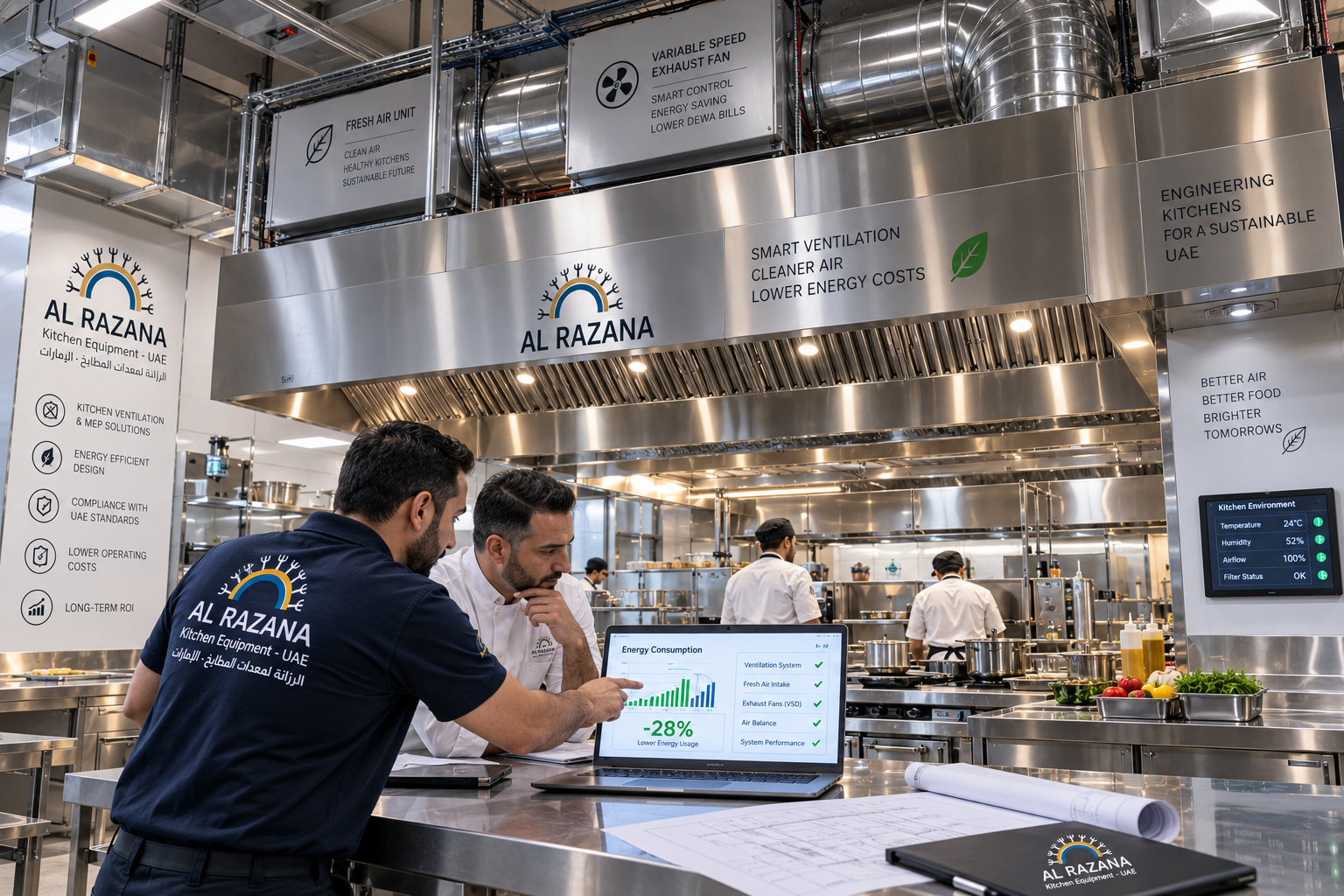
Kitchen exhaust systems can consume substantial energy, particularly when ventilation systems operate continuously.
A properly designed ventilation system should balance:
Cooking equipment requirements
Exhaust capacity
Fresh-air requirements
Kitchen temperature
Air movement
Building constraints
Oversized or poorly coordinated systems can create unnecessary energy demand.
At the same time, insufficient ventilation can create operational and environmental problems.
This is why ventilation should be considered during the commercial kitchen design stage, rather than added as an afterthought.
Smart Equipment Selection Can Reduce Heat Load
Energy efficiency isn't only about electricity consumption.
Commercial cooking equipment also generates heat.
In the UAE climate, additional kitchen heat can increase the workload placed on cooling and air-conditioning systems.
Choosing equipment that operates efficiently can therefore contribute to a more manageable kitchen environment.
This becomes particularly relevant in busy kitchens where multiple cooking appliances operate simultaneously during peak periods.
A properly planned kitchen should consider the combined impact of:
Cooking equipment + ventilation + kitchen heat + cooling requirements.
How DEWA Costs Can Influence Kitchen Planning
For businesses operating in Dubai, electricity consumption is directly relevant to overall operating expenses.
Restaurant owners and F&B managers should therefore review their expected electricity usage when planning a new kitchen.
Rather than assuming that one specific piece of equipment will produce a guaranteed DEWA saving, evaluate the complete operating profile.
Consider:
Equipment power requirements
Daily operating hours
Peak usage periods
Number of appliances
Refrigeration load
Ventilation load
Air-conditioning impact
Maintenance condition
Production volume
The actual financial impact will vary from one business to another.
For this reason, energy-saving decisions should be based on the restaurant's actual consumption data whenever possible.
Energy Efficiency Starts With Kitchen Design
Buying efficient equipment is only one part of the equation.
An inefficient kitchen layout can cause equipment to operate unnecessarily and force staff to spend additional time moving between stations.
A well-designed kitchen should organize:
Receiving
Storage
Preparation
Cooking
Plating
Service
Dishwashing
Waste handling
into a logical workflow.
This can reduce unnecessary movement and improve operational productivity.
For projects in Abu Dhabi, Sharjah, Ajman, Ras Al Khaimah, Fujairah, Al Ain, and Umm Al Quwain, the same principle applies: energy-efficient equipment works best when integrated into an efficient kitchen system.
Practical Ways to Reduce Commercial Kitchen Energy Consumption
1. Match Equipment Capacity to Actual Demand
Don't automatically choose oversized equipment.
A machine that is significantly larger than your production requirement may represent unnecessary capital and operating costs.
2. Avoid Leaving Equipment Running Unnecessarily
Where operationally appropriate, establish procedures for startup, shutdown, and standby periods.
3. Maintain Refrigeration Equipment
Dirty condenser components, damaged door seals, poor airflow, and neglected maintenance can affect refrigeration performance.
4. Keep Refrigerator and Freezer Doors Closed
Frequent or prolonged door opening increases the workload on refrigeration systems.
5. Maintain Cooking Equipment
Equipment should be regularly inspected and maintained according to manufacturer recommendations.
6. Optimize Production Batches
Better production planning can reduce unnecessary cooking cycles and equipment usage.
7. Review Kitchen Workflow
Reducing unnecessary movement and inefficient processes can improve productivity while supporting better resource utilization.
8. Monitor Consumption
Where practical, track electricity usage and compare consumption against production or sales volume.
This can reveal inefficiencies that are difficult to identify simply by looking at equipment specifications.
Energy Efficiency for Different UAE Food Businesses
Not every business should use the same equipment strategy.
Restaurants
Restaurants should focus on cooking efficiency, refrigeration, ventilation, and equipment capacity.
Cafés
Coffee machines, grinders, refrigeration, ice makers, blenders, and ventilation can become important energy considerations.
Hotels
Hotel kitchens may operate multiple production areas, restaurants, banquet kitchens, and staff facilities, making centralized energy planning particularly valuable.
Bakeries
Ovens, mixers, proofers, refrigeration, and production equipment can represent major energy loads.
Catering Kitchens
Catering businesses should evaluate equipment according to production volume and operating schedules.
Cloud Kitchens
Cloud kitchens can benefit from compact, high-efficiency equipment and carefully optimized workflows because available space and production density are often critical.
Central Kitchens
Large central kitchens should consider equipment efficiency at scale because energy consumption is multiplied across high production volumes.
How Maintenance Supports Energy Efficiency
Even efficient equipment can lose performance when poorly maintained.
A preventive maintenance program should cover relevant equipment such as:
Ovens
Fryers
Refrigerators
Freezers
Blast chillers
Dishwashers
Ice machines
Ventilation systems
Coffee equipment
Food preparation equipment
Maintenance can help identify problems before they become major operational failures.
For restaurant operators, this can support both equipment reliability and energy management.
Energy-Efficient Equipment vs Cheapest Equipment
One of the most common mistakes when opening a restaurant is comparing equipment purely by purchase price.
For example, Equipment A may cost less initially while Equipment B has better efficiency, durability, capacity, or maintenance characteristics.
The correct question is not:
"Which equipment is cheaper?"
It is:
"Which equipment provides the best long-term value for this kitchen?"
This requires considering:
Purchase cost
Energy consumption
Capacity
Maintenance
Downtime
Expected lifespan
Productivity
An F&B manager should therefore evaluate equipment as a long-term operational asset.
Building an Energy-Efficient Commercial Kitchen in the UAE
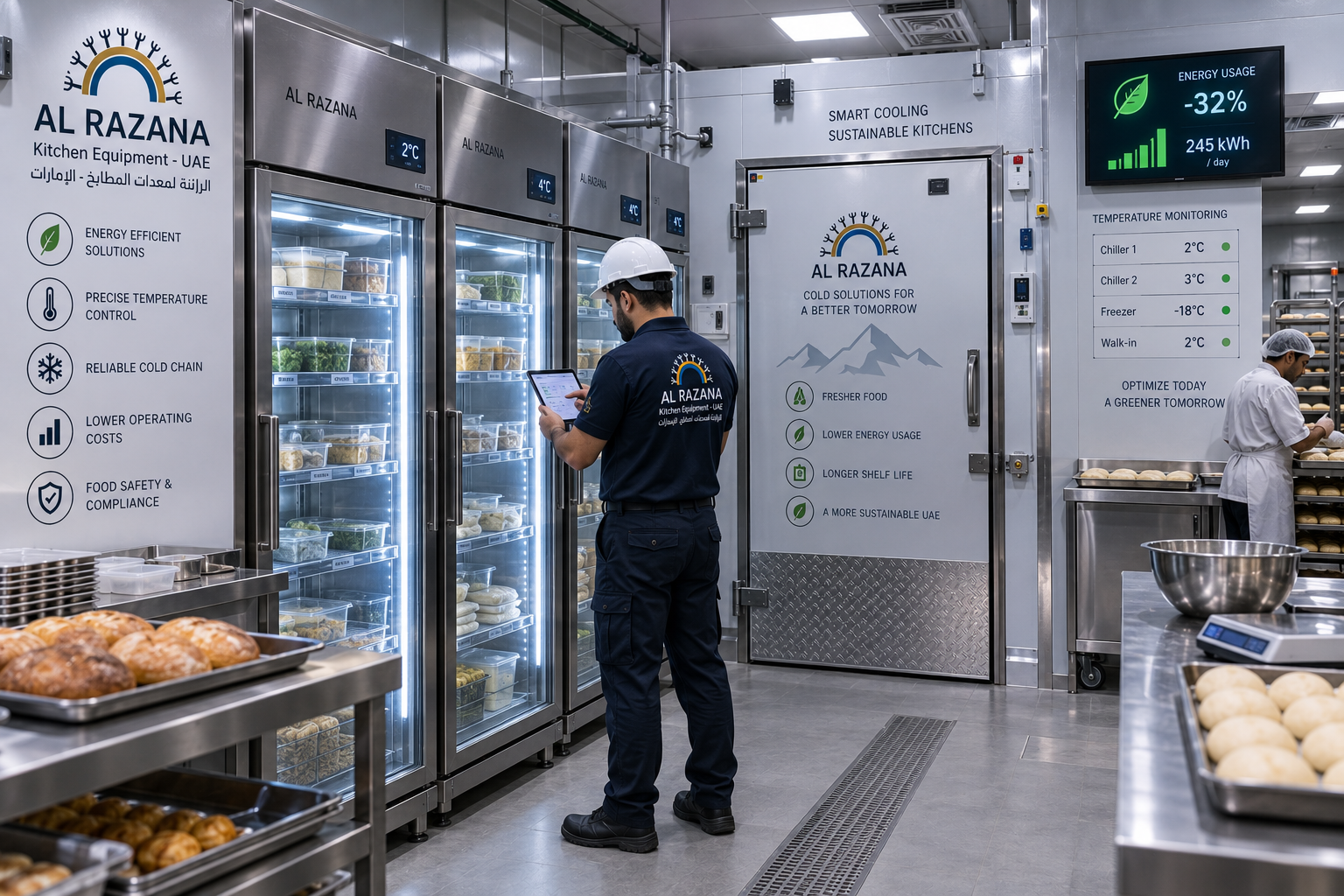
For a new restaurant or hotel project, energy efficiency should be considered from the beginning.
A practical planning process includes:
Step 1: Analyze the Menu
Identify cooking methods, production volumes, refrigeration needs, and preparation requirements.
Step 2: Determine Production Capacity
Estimate normal and peak production rather than selecting equipment based only on floor area.
Step 3: Design the Workflow
Create efficient zones for receiving, storage, preparation, cooking, service, and cleaning.
Step 4: Specify Equipment
Compare equipment based on capacity, specifications, energy requirements, reliability, and suitability.
Step 5: Coordinate MEP
Confirm electrical, plumbing, drainage, gas, ventilation, and other infrastructure requirements.
Step 6: Plan Maintenance
Consider how equipment will be serviced after installation.
Step 7: Monitor Performance
After opening, compare actual utility consumption with expected operating patterns.
Complete Commercial Kitchen Solutions From Al Razana
Choosing energy-efficient equipment requires more than selecting products from a catalog.
Al Razana Kitchen Equipment approaches commercial kitchens as complete operational systems.
Our Complete Commercial Kitchen Solutions can include:
Commercial kitchen consultancy
Kitchen layout and design
Workflow planning
Energy-conscious equipment selection
Commercial cooking equipment
Refrigeration planning
Custom stainless steel fabrication
Commercial kitchen ventilation coordination
Equipment installation
Commissioning
Preventive maintenance
After-sales support
Turnkey commercial kitchen projects
Whether you're developing a restaurant in Dubai Marina, a café in Jumeirah, a hotel kitchen in Abu Dhabi, or a catering facility in Sharjah, equipment should be selected according to the project's actual operational requirements.
The objective is not simply to purchase "green" equipment. It is to build a kitchen that uses space, equipment, energy, labor, and time efficiently.
Conclusion
Energy-efficient commercial kitchen equipment can play an important role in controlling operating costs for UAE restaurants, cafés, hotels, bakeries, catering businesses, and central kitchens.
However, efficiency shouldn't be evaluated by equipment specifications alone.
The best results come from combining:
Efficient equipment
Correct equipment sizing
Smart kitchen design
Effective workflow
Proper ventilation
Efficient refrigeration
Preventive maintenance
Consumption monitoring
For Dubai businesses, this can also support better control over electricity-related operating expenses, while businesses in Abu Dhabi, Sharjah, Ajman, Ras Al Khaimah, Fujairah, Al Ain, and Umm Al Quwain can apply the same principles to their own commercial kitchen operations.
A professionally planned kitchen can therefore deliver more than energy savings. It can improve productivity, reliability, staff efficiency, equipment performance, and long-term operational value.
Frequently Asked Questions
What is energy-efficient commercial kitchen equipment?
It refers to professional kitchen equipment designed or selected to achieve required production with efficient energy use. This can include ovens, induction cooking equipment, refrigeration, dishwashers, ventilation systems, and other commercial appliances.
Can energy-efficient equipment reduce DEWA costs?
It can contribute to lower electricity consumption, but the actual financial savings depend on equipment specifications, operating hours, production volume, kitchen design, and overall electricity usage. Savings should therefore be calculated based on actual operating data rather than assumed percentages.
Is induction cooking more energy efficient than gas?
Induction can provide efficient heat transfer and precise control, but whether it is the best solution depends on the restaurant's menu, production requirements, electrical infrastructure, cookware, and overall project economics.
Are combi ovens energy efficient?
Combi ovens can provide multiple cooking functions in one appliance and may help consolidate equipment. Their actual energy performance depends on the model, cooking program, workload, maintenance, and operating practices.
What commercial kitchen equipment consumes the most energy?
The answer varies by kitchen. Cooking equipment, refrigeration, ventilation, dishwashing, and other high-load appliances can all contribute significantly depending on operating hours and production volume.
How can restaurants reduce kitchen electricity consumption?
Restaurants can start by selecting appropriately sized equipment, maintaining refrigeration and cooking appliances, optimizing operating schedules, improving kitchen workflow, maintaining ventilation systems, and monitoring actual consumption.
Should I choose energy efficiency or lower equipment price?
The decision should consider total cost of ownership rather than purchase price alone. Energy consumption, maintenance, reliability, capacity, lifespan, and productivity can all influence the equipment's long-term value.
Can Al Razana help design an energy-efficient commercial kitchen in the UAE?
Yes. Al Razana can support commercial kitchen projects through consultancy, kitchen design, equipment selection and supply, refrigeration planning, stainless steel fabrication, installation, commissioning, preventive maintenance, and turnkey commercial kitchen solutions across the UAE.


