

Commercial Kitchen Turnkey Solutions UAE: Why One Partner Saves Time & Money
10 September 2026
Opening a commercial kitchen in the UAE involves much more than purchasing cooking equipment.
A successful project requires coordination between kitchen design, equipment procurement, stainless steel fabrication, refrigeration, ventilation, MEP requirements, installation, testing, commissioning, and ongoing maintenance.
When each component is handled by a different contractor, the restaurant owner or investor can end up managing multiple suppliers, schedules, technical specifications, invoices, and points of contact.
This is where commercial kitchen turnkey solutions in the UAE can provide a major advantage.
A turnkey partner can coordinate the different stages of the project under one structured approach, helping the investor move from an empty space to a functional professional kitchen with fewer coordination gaps.
Whether the project is a restaurant in Downtown Dubai, a café in Dubai Marina, a hotel kitchen in Abu Dhabi, or a catering facility in Sharjah, the objective remains the same:
Design it correctly, supply the right equipment, install it properly, and make the kitchen operational.
What Are Turnkey Commercial Kitchen Solutions?
A turnkey commercial kitchen solution covers multiple stages of the kitchen project through one coordinated provider.
Depending on the project scope, this can include:
Site survey
Kitchen layout design
Workflow planning
Equipment specification
Equipment procurement
Commercial kitchen equipment supply
Refrigeration
Stainless steel fabrication
Ventilation coordination
MEP coordination
Equipment installation
Testing
Commissioning
Staff training
Preventive maintenance
After-sales support
The exact scope depends on the project.
The important difference is that the investor does not have to coordinate every element independently.
Why Managing Multiple Kitchen Contractors Can Be Difficult
Consider a new restaurant project where:
One company designs the kitchen
Another supplies cooking equipment
Another supplies refrigeration
Another fabricates stainless steel
Another installs ventilation
Another handles electrical work
Another installs equipment
Another provides maintenance
Each company may complete its own scope correctly.
The problem is coordination between the scopes.
For example, the selected oven may require a particular utility connection, while the fabrication dimensions were based on an earlier specification.
The refrigeration layout may conflict with staff circulation.
The ventilation system may require adjustments because the cooking equipment changed.
The investor then becomes responsible for resolving the issue.
A turnkey model reduces this fragmentation by putting more responsibility for coordination on one project partner.
How a Turnkey Partner Saves Time
Time savings don't necessarily come from making every individual task faster.
They often come from reducing the number of coordination points.
One Main Point of Contact
Instead of communicating with several companies, the investor can work primarily with one project partner.
Better Communication Between Departments
Design, procurement, fabrication, and installation can be coordinated within the same project structure.
Fewer Specification Conflicts
Equipment specifications can be reviewed alongside the kitchen layout and fabrication requirements.
Easier Project Scheduling
Equipment delivery, fabrication, installation, and commissioning can be organized according to the overall project schedule.
Faster Problem Resolution
When an issue appears, the project team can identify which component is affected and coordinate the required solution.
How Turnkey Solutions Can Help Control Costs
A turnkey project isn't automatically cheaper than hiring several contractors.
The financial advantage comes from better coordination and fewer avoidable mistakes.
Potential cost-saving areas include:
Reduced design revisions
Fewer equipment specification errors
Less fabrication rework
Better equipment selection
Fewer installation conflicts
Reduced project delays
Better procurement coordination
More organized maintenance planning
For investors, avoiding one major mistake can sometimes be more valuable than negotiating a small discount on an individual equipment item.
Kitchen Design Comes First
A turnkey commercial kitchen project should begin with understanding the business.
Before equipment is selected, the project team should understand:
Restaurant concept
Menu
Production volume
Number of seats
Service model
Peak operating periods
Storage requirements
Staff workflow
Available kitchen area
Building constraints
Future expansion plans
This information forms the basis for the kitchen layout.
For a restaurant in Business Bay, for example, the available space and building conditions may lead to different design decisions than a large standalone catering facility in another UAE location.
Equipment Procurement as Part of the Turnkey Process
Once the kitchen requirements are understood, equipment can be specified according to actual operational needs.
This can include:
Cooking Equipment
Commercial ovens
Ranges
Fryers
Grills
Hot plates
Induction equipment
Cooking suites
Refrigeration
Upright refrigerators
Freezers
Undercounter refrigeration
Display refrigeration
Walk-in cold rooms
Blast chillers
Preparation Equipment
Food processors
Mixers
Slicers
Preparation tables
Food preparation machinery
Warewashing
Undercounter dishwashers
Hood-type dishwashers
Glasswashers
Pot-washing systems
Beverage Equipment
Espresso machines
Coffee grinders
Ice machines
Juice equipment
Blenders
Beverage dispensers
Equipment should be selected based on the project's requirements rather than simply filling the kitchen with standard products.
Stainless Steel Fabrication in a Turnkey Kitchen
Custom stainless steel fabrication is another important component.
A professional kitchen may require:
Work tables
Preparation counters
Sinks
Shelving
Cabinets
Equipment stands
Wall shelves
Storage counters
Service counters
The dimensions should be coordinated with the approved kitchen layout and equipment specifications.
This is one area where integrated project management can be particularly useful.
If the equipment supplier and fabricator work from the same approved specifications, the risk of dimensional conflicts can be reduced.
MEP Coordination Is Critical
Commercial kitchen equipment can have specific:
Electrical requirements
Gas requirements
Water requirements
Drainage requirements
Ventilation requirements
Exhaust requirements
These requirements should be considered during design.
Changing equipment after MEP works are completed can result in additional work and project delays.
A turnkey approach allows equipment specifications to be incorporated into the wider kitchen infrastructure planning.
Commercial Kitchen Ventilation and Turnkey Planning
Ventilation is one of the areas that should never be treated as an afterthought.
Cooking equipment generates heat, smoke, grease, and other emissions that need to be managed appropriately.
The ventilation strategy should be coordinated with:
Cooking equipment
Hood dimensions
Exhaust requirements
Fresh-air requirements
Duct routing
Kitchen layout
Building constraints
This becomes particularly important in restaurants located inside Dubai malls, hotels, towers, and mixed-use developments, where available routes and building services can impose additional design constraints.
Refrigeration Planning
Refrigeration should also be integrated into the overall kitchen plan.
The project team should determine:
Required storage volume
Product categories
Temperature requirements
Walk-in vs standalone refrigeration
Preparation refrigeration
Blast chilling requirements
Equipment location
Service access
Correct refrigeration planning helps prevent congestion and supports a more organized food-production workflow.
Installation and Commissioning
Supplying equipment is only one part of a turnkey project.
The equipment must also be installed correctly.
Installation can involve:
Positioning
Leveling
Utility connections
Drainage
Gas connections where applicable
Electrical connections
Ventilation coordination
Refrigeration connections
Operational testing
After installation, commissioning verifies that the kitchen equipment is ready for operation.
This can include:
Startup testing
Temperature verification
Operational checks
Control verification
Calibration where applicable
Refrigeration testing
Dishwasher testing
Staff familiarization
Preventive Maintenance After Opening
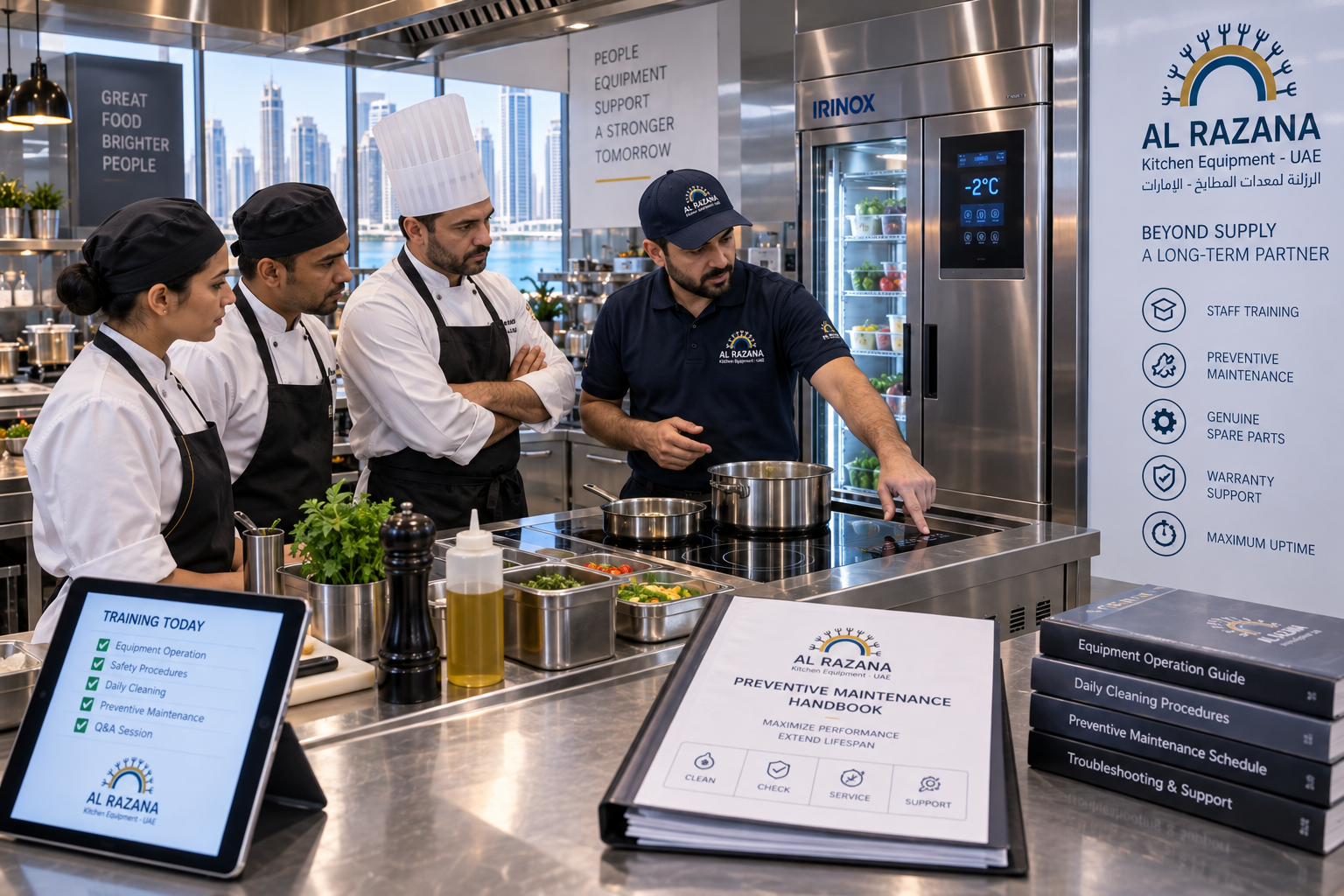
The relationship with the kitchen supplier shouldn't necessarily end when the restaurant opens.
Commercial kitchen equipment operates under demanding conditions, making maintenance an important part of protecting the investment.
Preventive maintenance can include inspection and servicing of:
Cooking equipment
Refrigeration
Dishwashers
Ice machines
Coffee equipment
Food preparation equipment
Ventilation systems
A maintenance strategy can help identify developing issues before they become major operational failures.
Turnkey vs Multiple Suppliers
Factor | Turnkey Partner | Multiple Suppliers |
Main point of contact | One | Several |
Design coordination | Centralized | Requires coordination |
Equipment procurement | Integrated | Separate |
Fabrication | Coordinated | Separate |
Installation | Coordinated | Multiple teams |
Project scheduling | Centralized | More complex |
Problem resolution | More centralized | Can involve several parties |
Maintenance | Can remain with same partner | Usually separate |
Investor involvement | Potentially lower | Potentially higher |
Neither approach is automatically suitable for every project.
For larger or more complex commercial kitchens, however, centralized coordination can significantly simplify project management.
When Should You Choose a Turnkey Kitchen Solution?
Turnkey solutions can be particularly useful for:
New Restaurants
Investors opening a restaurant from an empty shell can benefit from having design, procurement, fabrication, and installation coordinated.
Hotels
Hotel projects can involve multiple kitchens and specialized food-production areas.
Catering Companies
High-volume catering operations often require detailed workflow and equipment coordination.
Cloud Kitchens
Compact spaces require careful integration of equipment and workflow.
Restaurant Groups
Multi-branch operators may benefit from standardized equipment specifications and project processes.
Central Kitchens
Large production facilities require extensive coordination between equipment, utilities, storage, refrigeration, and workflow.
Turnkey Solutions for Dubai Restaurant Projects
Dubai has a highly diverse F&B market.
A project in Jumeirah may be a compact neighborhood restaurant.
A concept in Dubai Marina may have high customer turnover and limited back-of-house space.
A restaurant in Downtown Dubai may operate in a high-density commercial environment.
A premium concept in DIFC may require a different operational and design approach.
A hospitality project on Palm Jumeirah can involve complex coordination with the wider property development.
The kitchen solution should therefore be customized to the project rather than copied from another restaurant.
Turnkey Commercial Kitchens Across the UAE
The same integrated approach can be applied beyond Dubai.
Projects in:
Abu Dhabi
Sharjah
Ajman
Ras Al Khaimah
Fujairah
Al Ain
Umm Al Quwain
can all require different equipment combinations, kitchen sizes, production volumes, and site conditions.
A professional turnkey provider should begin with the individual project's requirements rather than applying a generic equipment package.
How to Select a Turnkey Commercial Kitchen Partner
Before choosing a provider, investors should evaluate:
1. Design Capability
Can the company develop a practical commercial kitchen layout?
2. Equipment Knowledge
Can it recommend equipment according to your menu and production requirements?
3. Fabrication
Does it provide or coordinate custom stainless steel fabrication?
4. Installation
Can the team install and commission the equipment?
5. Project Management
Can multiple project stages be coordinated under one schedule?
6. After-Sales Support
Is technical support available after opening?
7. Maintenance
Can the supplier provide preventive maintenance?
8. Experience
Does the company understand restaurants, cafés, hotels, catering kitchens, and other professional foodservice environments?
What Should Be Included in a Turnkey Kitchen Quotation?
Don't accept a vague "turnkey kitchen" description.
Request a detailed scope that clearly identifies:
Kitchen design
Equipment list
Equipment specifications
Quantities
Stainless steel fabrication
Refrigeration
Ventilation scope
Installation
Testing
Commissioning
Delivery
Warranty
Maintenance
Staff training
Exclusions
A detailed scope makes it easier to compare proposals from different companies.
Questions Investors Should Ask Before Signing
Before appointing a turnkey kitchen provider, ask:
Who is responsible for the final kitchen design?
Who specifies the equipment?
Who coordinates MEP requirements?
Who manufactures the stainless steel?
Who handles installation?
Who commissions the equipment?
What happens if equipment specifications change?
Who handles warranty claims?
Are spare parts available?
Is preventive maintenance available after opening?
What is excluded from the turnkey scope?
The answers should be documented clearly in the project agreement.
A Complete Turnkey Kitchen Project Workflow
A professional project can follow this sequence:
Step 1: Initial Consultation
Understand the concept, menu, budget, site, and operational goals.
Step 2: Site Survey
Measure the space and identify existing infrastructure and constraints.
Step 3: Kitchen Design
Develop the workflow, zones, equipment positions, and service areas.
Step 4: Equipment Specification
Select the appropriate equipment according to the menu and production requirements.
Step 5: MEP Coordination
Coordinate electrical, plumbing, drainage, gas, ventilation, and other requirements.
Step 6: Procurement
Order the approved equipment and manage delivery schedules.
Step 7: Stainless Steel Fabrication
Manufacture custom workstations, sinks, counters, shelving, and other fabrication.
Step 8: Site Preparation
Prepare utilities and infrastructure for installation.
Step 9: Equipment Installation
Position and connect the equipment according to the approved plan.
Step 10: Testing & Commissioning
Test the kitchen systems and equipment before opening.
Step 11: Staff Training
Ensure the operating team understands the equipment and workflow.
Step 12: Handover
Provide the necessary documentation and transition the kitchen to operations.
Step 13: After-Sales & Maintenance
Continue supporting the kitchen after opening.
Why Al Razana for Turnkey Commercial Kitchen Solutions?
Al Razana Kitchen Equipment provides Complete Commercial Kitchen Solutions for businesses across Dubai and the UAE.
Instead of approaching a kitchen as a collection of individual equipment purchases, Al Razana can support the wider project through:
Commercial kitchen consultancy
Site assessment
Kitchen design
Workflow planning
Equipment selection
Commercial kitchen equipment supply
Refrigeration solutions
Custom stainless steel fabrication
Kitchen infrastructure coordination
Equipment installation
Testing and commissioning
Preventive maintenance
After-sales support
Turnkey commercial kitchen projects
This integrated approach can be particularly valuable for investors who want to minimize the number of separate suppliers they need to coordinate.
The objective is to deliver a kitchen that is not only equipped, but properly planned, installed, tested, and ready for daily commercial operation.
The Real Value of One Kitchen Partner
The biggest advantage of a turnkey approach isn't simply having one company to call.
It is having one project structure connecting the different parts of the kitchen.
Design affects equipment.
Equipment affects MEP.
Equipment dimensions affect fabrication.
Fabrication affects installation.
Installation affects commissioning.
Commissioning affects opening readiness.
Maintenance affects long-term performance.
When these elements are planned together, the project becomes easier to manage.
For an investor, this can mean fewer coordination problems, better visibility over the project, and greater confidence that the finished kitchen will match the original operational requirements.
Conclusion
Commercial kitchen turnkey solutions in the UAE provide investors with an alternative to managing multiple independent suppliers throughout a complex kitchen project.
Instead of separately coordinating design, equipment procurement, fabrication, refrigeration, ventilation, installation, commissioning, and maintenance, a turnkey approach brings these functions into one coordinated project structure.
This can help reduce communication gaps, minimize avoidable errors, simplify scheduling, and improve project control.
From a café in Dubai Marina to a restaurant in Downtown Dubai, a hotel kitchen in Abu Dhabi, or a catering facility in Sharjah, the principle remains the same:
A commercial kitchen should be designed and delivered as one integrated system.
For investors planning a new restaurant, hotel, café, catering facility, cloud kitchen, or central production kitchen, choosing an experienced turnkey partner can transform a complicated procurement process into a more organized path from concept to opening.
Frequently Asked Questions
What are commercial kitchen turnkey solutions?
Turnkey commercial kitchen solutions combine multiple project services under one coordinated provider, potentially including consultancy, design, equipment supply, fabrication, MEP coordination, installation, commissioning, and maintenance.
Is a turnkey kitchen more expensive?
Not necessarily. The total cost depends on the project scope and specifications. A turnkey solution can potentially reduce costs associated with coordination problems, design revisions, rework, delays, and purchasing mistakes.
What is included in a turnkey commercial kitchen?
The scope varies by provider and project, but can include kitchen design, equipment procurement, refrigeration, stainless steel fabrication, installation, commissioning, staff training, and maintenance.
Why use one supplier for a commercial kitchen?
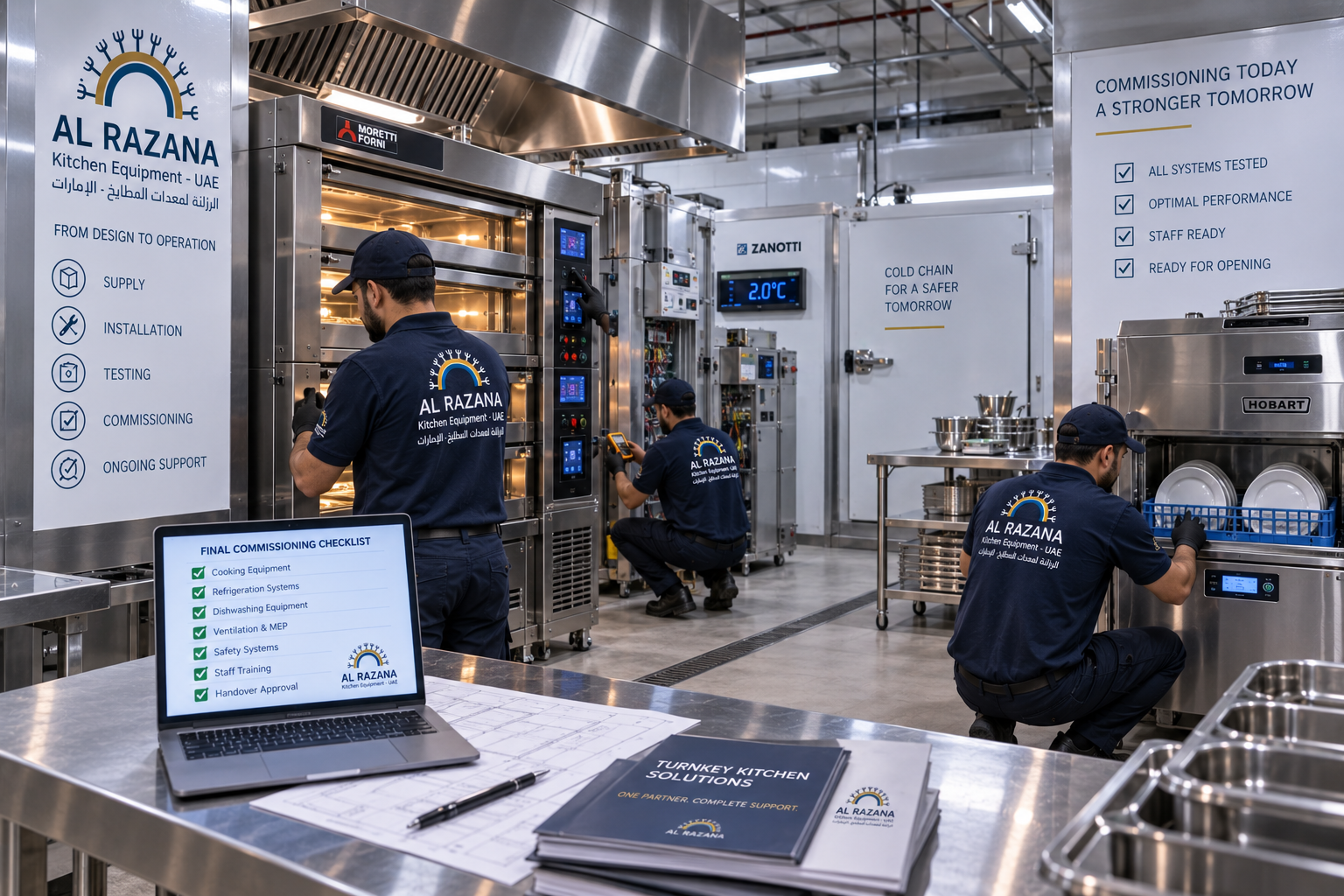
A single project partner can simplify communication and coordinate design, equipment, fabrication, installation, and commissioning, reducing the number of separate interfaces the investor has to manage.
Can turnkey solutions include kitchen design?
Yes. Commercial kitchen design and workflow planning are commonly important components of a turnkey kitchen project.
Does turnkey include stainless steel fabrication?
It can. Custom stainless steel fabrication such as work tables, sinks, counters, shelving, cabinets, and equipment stands can be incorporated into the turnkey scope.
Does Al Razana provide turnkey commercial kitchen solutions in Dubai?
Yes. Al Razana provides Complete Commercial Kitchen Solutions that can include consultancy, design, equipment supply, stainless steel fabrication, installation, commissioning, maintenance, and after-sales support.
Does Al Razana serve commercial kitchens outside Dubai?
Yes. Al Razana supports commercial kitchen requirements across the UAE, including Abu Dhabi, Sharjah, Ajman, Ras Al Khaimah, Fujairah, Al Ain, and Umm Al Quwain, depending on project scope and requirements.
Is turnkey suitable for a small café?
It can be. Even a relatively small café may require coordination between coffee equipment, refrigeration, preparation areas, stainless steel fabrication, plumbing, electrical requirements, and workflow.
What should I check before hiring a turnkey kitchen company?
Review the company's design capabilities, equipment portfolio, fabrication capabilities, installation and commissioning services, project experience, warranty process, spare-parts availability, maintenance services, and—most importantly—the exact scope and exclusions in the quotation.


