

Commercial Kitchen Consultancy UAE: Why Expert Planning Reduces Costs
10 September 2026
Opening a restaurant in the UAE involves significant investment, and many expensive mistakes happen before the kitchen is even installed.
A restaurant owner may have a strong concept, an attractive location, and an excellent menu, but if the commercial kitchen is poorly planned, the business can face problems with workflow, equipment capacity, storage, ventilation, utilities, staffing, and operating costs.
This is where commercial kitchen consultancy in the UAE becomes valuable.
A professional consultant helps translate the restaurant concept into a practical kitchen system by considering the menu, production requirements, available space, workflow, equipment, utilities, budget, and future operational needs.
For projects in Dubai, Abu Dhabi, Sharjah, Ajman, Ras Al Khaimah, Fujairah, Al Ain, and Umm Al Quwain, expert planning can help investors make better decisions before committing significant capital to equipment and construction.
What Is Commercial Kitchen Consultancy?
Commercial kitchen consultancy is the professional planning and advisory process used to develop an efficient foodservice kitchen.
It can cover several stages, including:
Concept analysis
Feasibility assessment
Menu analysis
Production planning
Kitchen workflow planning
Space utilization
Equipment specification
Equipment selection
Kitchen layout development
Refrigeration planning
Storage planning
MEP coordination
Ventilation coordination
Procurement support
Installation coordination
Commissioning support
Operational recommendations
The exact scope depends on the size and complexity of the project.
For a small café, consultancy may focus on maximizing a limited footprint.
For a hotel, central kitchen, catering facility, or restaurant group, the process can involve significantly more detailed planning.
Why Should You Hire a Commercial Kitchen Consultant?
A commercial kitchen is not simply a room filled with equipment.
It is a production environment where people, food, equipment, utilities, storage, and waste move continuously.
Poor planning can result in:
Unnecessary staff movement
Insufficient preparation space
Equipment bottlenecks
Poor storage
Refrigeration problems
Difficult cleaning
Equipment conflicts
MEP changes
Excessive capital expenditure
Reduced productivity
Consultancy moves many of these decisions to the planning stage, where changes are generally easier to make than after installation.
Start With a Kitchen Feasibility Study
Before designing the kitchen, the consultant should understand whether the proposed space can support the intended operation.
A feasibility assessment can consider:
Restaurant Concept
What type of foodservice business is being developed?
Examples include:
Fine dining
Casual dining
QSR
Café
Bakery
Catering operation
Cloud kitchen
Hotel restaurant
Central production kitchen
Menu
The menu determines the cooking, preparation, refrigeration, and storage requirements.
Production Volume
The kitchen should be designed around expected production, including peak periods.
Available Space
The consultant should assess the available footprint and identify how effectively it can support the operation.
Operational Model
Table service, takeaway, delivery, buffet, catering, and hybrid models can require different kitchen workflows.
Menu Analysis: The Foundation of Equipment Planning
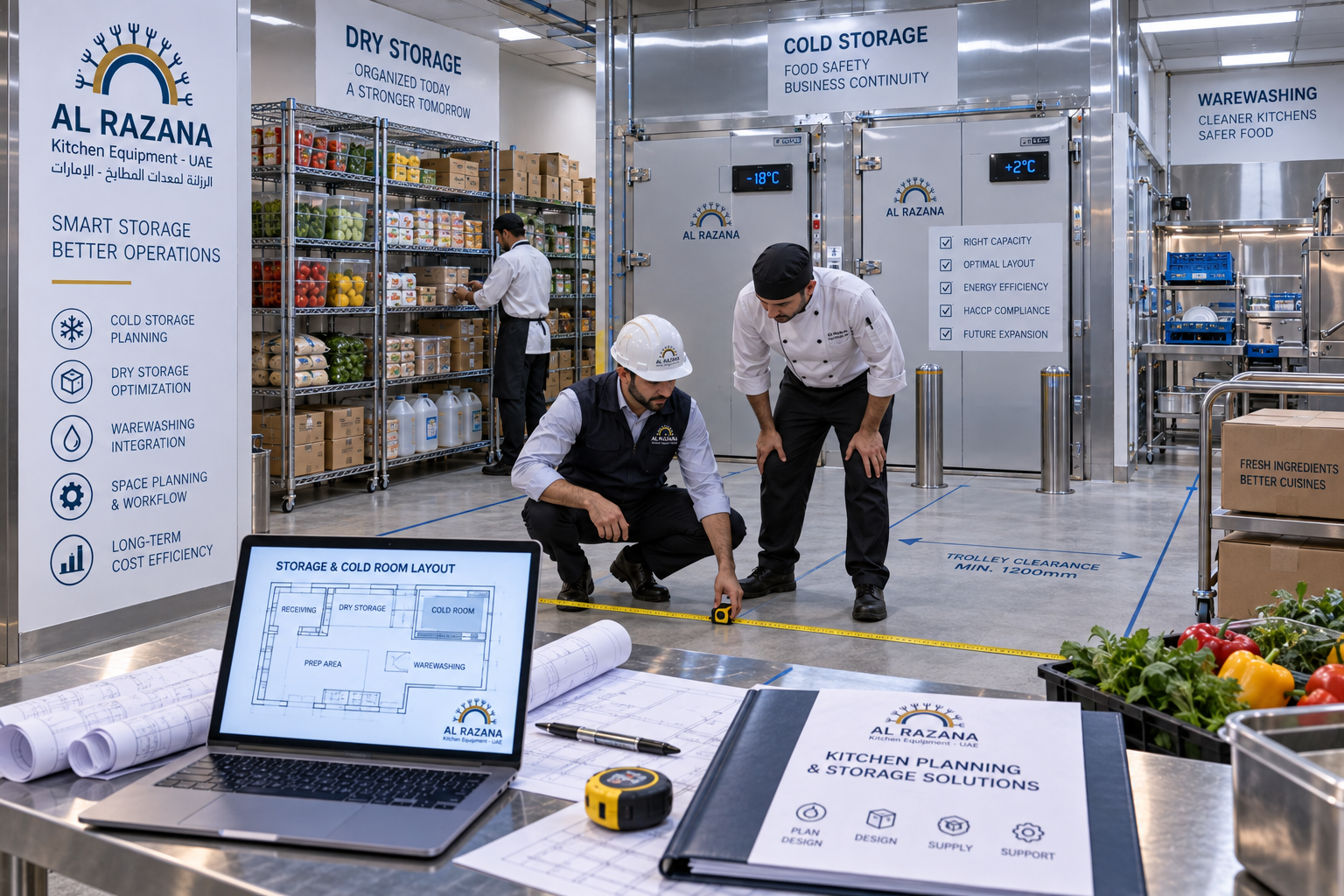
One of the most important consultancy activities is understanding the menu.
A consultant can map menu items to their production processes.
For example:
Ingredient receiving → storage → preparation → cooking → holding → plating → service
Each stage requires appropriate space and equipment.
A pizza concept may need dough preparation, proofing, refrigeration, pizza ovens, and dedicated assembly areas.
A specialty café may require espresso equipment, grinders, refrigeration, ice production, blending, and beverage preparation.
A hotel kitchen may require several specialized production areas.
The equipment list should therefore be built around the menu rather than simply selecting standard kitchen packages.
Commercial Kitchen Workflow Planning
A professional kitchen should allow staff to move logically between workstations.
Typical zones may include:
Receiving
Dry storage
Cold storage
Preparation
Cooking
Plating
Service
Dishwashing
Waste handling
The objective is to reduce unnecessary movement and avoid conflicts between different kitchen activities.
For example, dirty dish movement should not unnecessarily interfere with food preparation or service.
This becomes particularly important during peak service periods.
Kitchen Layout Optimization
A consultant can help determine where each major function should be positioned.
Important considerations include:
Staff circulation
Equipment dimensions
Workstation relationships
Preparation space
Storage access
Refrigeration access
Dishwashing flow
Service routes
Cleaning access
Maintenance access
The objective is not simply to fit everything into the available area.
The objective is to create a kitchen that works efficiently every day.
Equipment Specification and Selection
A commercial kitchen consultant can help define the specifications required for each equipment category.
This can include:
Cooking
Ovens
Ranges
Fryers
Grills
Induction equipment
Hot plates
Refrigeration
Upright refrigerators
Freezers
Preparation counters
Display refrigeration
Walk-in chillers
Blast chillers
Preparation
Mixers
Slicers
Food processors
Preparation tables
Warewashing
Dishwashers
Glasswashers
Pot-washing systems
Beverage
Espresso machines
Coffee grinders
Ice machines
Juice equipment
Blenders
The important question is not simply "What equipment do we need?"
It is:
"What equipment is appropriate for our menu, volume, space, workflow, and budget?"
How Consultancy Can Reduce Equipment Costs
Expert planning can reduce unnecessary equipment purchases.
Without proper analysis, investors may:
Over-specify equipment
Purchase excessive quantities
Select oversized appliances
Buy equipment that duplicates another function
Choose unsuitable equipment
Discover missing equipment later
A consultant can identify what is actually required for the operation.
This doesn't necessarily mean choosing the cheapest equipment.
It means creating a more rational relationship between investment and operational requirements.
Avoid Oversized Commercial Kitchen Equipment
Bigger isn't always better.
An oversized oven, refrigerator, fryer, or preparation machine can:
Consume unnecessary space
Increase capital expenditure
Increase utility requirements
Make workflow less efficient
Reduce available workspace
Equipment should be sized according to actual and expected production.
At the same time, the consultant should consider peak demand so the kitchen doesn't become a bottleneck.
MEP Coordination Starts During Consultancy
Commercial kitchen equipment has infrastructure requirements.
Depending on the equipment, this may involve:
Electrical power
Gas
Water
Drainage
Exhaust
Fresh air
Refrigeration services
If these requirements aren't identified early, changes may be required later.
A consultancy process can therefore help coordinate equipment specifications with the wider building services strategy.
This is particularly important for commercial kitchen projects in Dubai malls, hotels, towers, mixed-use developments, and large hospitality projects.
Ventilation Planning
Cooking equipment generates heat, smoke, grease, and other emissions.
Ventilation planning should therefore be integrated with equipment selection and kitchen layout.
The consultant should consider the relationship between:
Cooking equipment
Extraction hoods
Exhaust ducting
Fresh-air systems
Kitchen layout
Building infrastructure
An efficient ventilation strategy can also contribute to a more comfortable working environment.
For more information, see Restaurant Ventilation System UAE: Complete Exhaust & Fresh Air Guide.
Refrigeration and Cold Storage Planning
Poor refrigeration planning can create operational problems even when high-quality refrigerators are purchased.
Consultancy should consider:
Required storage capacity
Product categories
Temperature requirements
Walk-in vs standalone equipment
Preparation refrigeration
Blast chilling
Delivery frequency
Equipment location
Staff access
Maintenance access
A restaurant that receives deliveries frequently may have different cold-storage requirements from a central kitchen serving several branches.
Storage Planning
Storage is frequently underestimated during restaurant design.
A professional kitchen needs space for:
Dry ingredients
Refrigerated products
Frozen products
Packaging
Smallwares
Cleaning materials
Kitchen utensils
Operating supplies
Insufficient storage can cause products and equipment to occupy preparation or circulation areas.
The result is a less organized and less efficient kitchen.
Stainless Steel Fabrication Planning
Custom stainless steel fabrication should be based on the final kitchen design.
It can include:
Work tables
Sinks
Shelving
Cabinets
Preparation counters
Equipment stands
Storage counters
Service counters
A consultant can coordinate fabrication dimensions with the equipment layout.
This helps create a more integrated kitchen instead of a collection of individually purchased components.
Consultancy Before Construction Saves More Than Consultancy After Construction
The earlier professional planning begins, the more decisions can be made before expensive work is completed.
Changing a layout during the design stage is very different from changing it after:
Flooring is completed
Drainage is installed
Electrical services are installed
Ductwork is fabricated
Stainless steel is manufactured
Equipment is delivered
Early planning therefore has significant value.
The consultant's role is partly to identify potential problems before they become physical problems on site.
Commercial Kitchen Consultancy for Different UAE Businesses
Restaurants
Consultancy can focus on menu production, workflow, equipment, storage, and service.
Cafés
The focus may be compact layouts, beverage production, refrigeration, and fast customer service.
Hotels
Hotel projects can involve multiple kitchens, banquet operations, breakfast production, pastry, and specialized foodservice areas.
Bakeries
Consultancy should account for dough production, mixing, proofing, baking, cooling, storage, and dispatch.
Catering Companies
High-volume production requires careful capacity and workflow planning.
Cloud Kitchens
Limited space makes workflow optimization and equipment positioning especially important.
Central Kitchens
Central production facilities require detailed capacity planning, logistics, storage, refrigeration, and standardized production systems.
Commercial Kitchen Consultancy in Dubai
Dubai's restaurant market includes an enormous variety of concepts and property types.
A consultant may need to design a compact kitchen for a café in Jumeirah, a high-volume restaurant in Downtown Dubai, a delivery-focused operation in Business Bay, or a premium hospitality concept in DIFC.
Other locations such as Dubai Marina, JBR, Palm Jumeirah, Dubai Hills, and Al Barsha can also present different space, access, and operational considerations.
The correct kitchen design is therefore based on the individual site and concept—not simply the location.
Commercial Kitchen Consultancy Across the UAE
The same planning principles apply across the UAE, while the project requirements can vary.
A restaurant in Abu Dhabi may have different site and operational requirements from a café in Sharjah.
A catering facility in Ajman may require a different production strategy from a hotel kitchen in Ras Al Khaimah.
Projects in Fujairah, Al Ain, and Umm Al Quwain can also require customized equipment and workflow planning based on their specific concepts and spaces.
Professional consultancy should adapt to these differences.
What Does a Commercial Kitchen Consultant Deliver?
Depending on project scope, deliverables may include:
Kitchen concept assessment
Feasibility recommendations
Kitchen zoning
Workflow planning
Equipment schedule
Equipment specifications
Kitchen layout
Storage planning
Refrigeration planning
Stainless steel fabrication requirements
MEP requirements
Ventilation coordination
Procurement recommendations
Installation coordination
Commissioning support
The exact deliverables should be agreed upon before the consultancy begins.
How to Choose a Commercial Kitchen Consultant in the UAE
Before hiring a consultant, ask:
Does the Consultant Understand F&B Operations?
Kitchen design should be based on real operational requirements rather than only architectural drawings.
Can They Specify Equipment?
A consultant should understand the technical differences between equipment categories and models.
Can They Coordinate With Contractors?
Kitchen design needs to interact with MEP, fabrication, fit-out, and equipment installation.
Do They Understand Workflow?
The layout should support staff productivity and food production.
Do They Consider Maintenance?
Equipment should remain accessible after installation.
Do They Consider Future Growth?
A scalable kitchen can be more valuable than a design that only works at today's production level.
Commercial Kitchen Consultancy vs Equipment Supply
An equipment supplier provides products.
A consultant focuses on determining what the project actually needs.
The best commercial kitchen projects can combine both capabilities.
Instead of asking:
"What equipment can we buy?"
the project should begin with:
"What does this kitchen need to produce the menu efficiently?"
The equipment can then be selected accordingly.
From Consultancy to Turnkey Kitchen Delivery
For investors who want a more integrated process, consultancy can become the first stage of a turnkey commercial kitchen project.
The workflow can progress from:
Consultancy → Design → Equipment Specification → Procurement → Fabrication → Installation → Commissioning → Maintenance
This creates a clear relationship between the initial operational requirements and the finished kitchen.
For a complete overview, see Commercial Kitchen Turnkey Solutions UAE: Why One Partner Saves Time & Money.
Why Choose Al Razana for Commercial Kitchen Consultancy?
Al Razana Kitchen Equipment provides Complete Commercial Kitchen Solutions, combining consultancy with practical kitchen design, equipment, fabrication, installation, and after-sales support.
Depending on the project, support can include:
Commercial kitchen consultancy
Feasibility assessment
Site survey
Kitchen layout planning
Workflow optimization
Equipment specification
Equipment procurement
Commercial kitchen equipment supply
Refrigeration planning
Custom stainless steel fabrication
Ventilation coordination
Installation
Commissioning
Preventive maintenance
After-sales support
Turnkey kitchen solutions
This integrated approach allows the kitchen to be considered as one operational system from the beginning.
For restaurant owners, this can simplify decision-making and reduce the risk of discovering major design or equipment problems after construction has already started.
Commercial Kitchen Consultancy Checklist
Before starting a project, make sure the following questions have been addressed:
Is the restaurant concept defined?
Is the menu finalized or sufficiently developed?
Is expected production volume understood?
Has the site been surveyed?
Is the kitchen footprint confirmed?
Has workflow been analyzed?
Has kitchen zoning been established?
Has equipment capacity been calculated?
Are equipment specifications defined?
Has refrigeration been planned?
Has storage been planned?
Have MEP requirements been identified?
Has ventilation been coordinated?
Has stainless steel fabrication been considered?
Has equipment service access been considered?
Has future expansion been considered?
Has the procurement strategy been defined?
Has installation been planned?
Has commissioning been included?
If several answers are "no," the project may benefit from professional consultancy before procurement or construction proceeds.
Conclusion
Commercial kitchen consultancy in the UAE is fundamentally about making better decisions before money is committed to construction and equipment.
A professional consultant can help connect the restaurant's:
Concept → Menu → Production → Workflow → Layout → Equipment → MEP → Fabrication → Installation → Operations
This integrated approach can reduce unnecessary purchases, avoid layout problems, improve workflow, and make the kitchen easier to operate and maintain.
For projects in Dubai, Abu Dhabi, Sharjah, Ajman, Ras Al Khaimah, Fujairah, Al Ain, and Umm Al Quwain, professional kitchen planning can provide investors and restaurant owners with greater confidence before moving into procurement and construction.
The ultimate goal is not simply to design a kitchen that fits the available space.
It is to create a kitchen that supports the business, the staff, the menu, and the customer experience every day.
Frequently Asked Questions
What is commercial kitchen consultancy?
Commercial kitchen consultancy is the professional planning and advisory process used to determine the layout, workflow, equipment, storage, refrigeration, infrastructure, and operational requirements of a commercial foodservice kitchen.
Why do restaurants need a kitchen consultant?
A consultant can help identify potential design, workflow, capacity, equipment, and infrastructure problems before they become expensive changes during construction or installation.
What does a commercial kitchen consultant do?
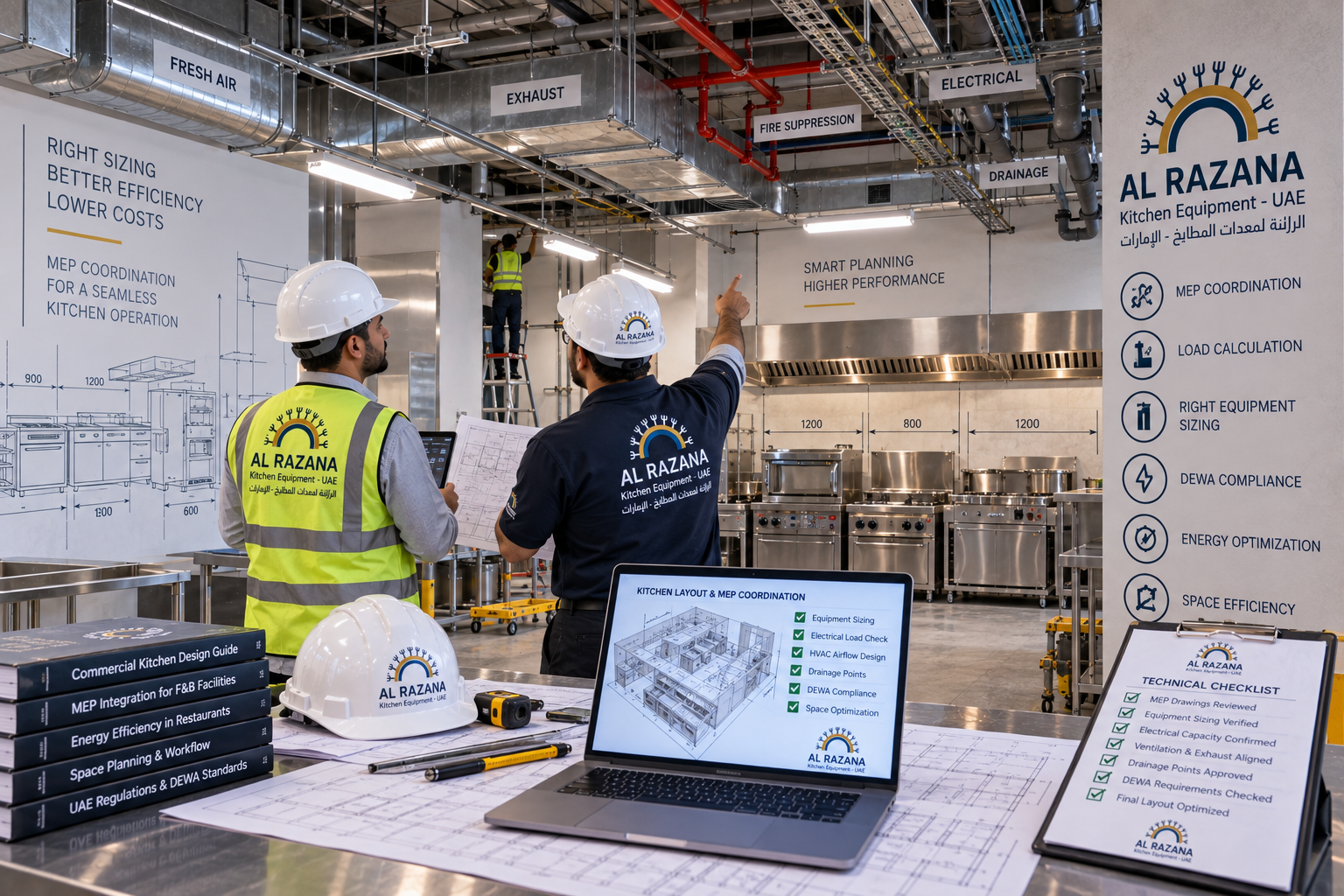
Depending on the project, a consultant may conduct feasibility assessments, analyze menus, plan workflow, develop kitchen layouts, specify equipment, coordinate MEP requirements, plan refrigeration and storage, and support procurement and installation.
Can kitchen consultancy reduce equipment costs?
It can help reduce unnecessary or incorrectly specified equipment purchases by matching equipment capacity and functionality to the restaurant's actual menu and production requirements.
When should I hire a commercial kitchen consultant?
Ideally, consultancy should begin during the early planning stage, before major equipment purchases, fabrication, and MEP works are finalized.
Does kitchen consultancy include equipment selection?
It can. Equipment specification and selection are important parts of many commercial kitchen consultancy projects.
Can Al Razana provide commercial kitchen consultancy in Dubai?
Yes. Al Razana can provide commercial kitchen consultancy and related services as part of its Complete Commercial Kitchen Solutions for restaurant, café, hotel, catering, bakery, cloud kitchen, and other foodservice projects.
Does Al Razana provide consultancy outside Dubai?
Al Razana supports commercial kitchen projects across the UAE, including Abu Dhabi, Sharjah, Ajman, Ras Al Khaimah, Fujairah, Al Ain, and Umm Al Quwain, depending on the project requirements.
Can consultancy be combined with a turnkey kitchen project?
Yes. Consultancy can form the first stage of an integrated turnkey project covering design, equipment procurement, stainless steel fabrication, installation, commissioning, and maintenance.


